Table of Contents
- Bali’s Unique Construction Landscape Challenges and Opportunities
- The Rise of Bamboo Architecture as a Smart Solution
- Embracing Sustainable Materials Beyond Bamboo
- Green Building Principles and Design Innovations
- Integrating Smart Technologies in Balinese Builds
- Community and Cultural Integration in Modern Construction
- The Future of Innovative Construction in Bali
- Conclusions
Bali, a jewel in the Indonesian archipelago, faces unique challenges in its booming construction sector. As tourism and development surge, the demand for new infrastructure grows. This article delves into the innovative construction solutions emerging across the island, blending traditional Balinese wisdom with cutting-edge sustainable practices. We will explore how smart design and material choices are paving the way for a greener, more resilient future for Bali’s built environment.
Bali’s Unique Construction Landscape Challenges and Opportunities
The construction landscape in Bali is experiencing a profound shift, moving towards innovative and sustainable methodologies to address the pressures of rapid development. Among these, the resurgence of bamboo architecture stands out as a truly smart solution, offering a harmonious blend of ecological responsibility and structural ingenuity. This incredible natural material, once seen as a temporary or rustic option, is now being embraced by commercial construction in Bali and residential projects alike, thanks to advanced engineering and treatment.
Bamboo boasts an impressive array of environmental benefits that make it ideal for sustainable building. Its growth rate is astonishingly fast, maturing in just 3-5 years compared to decades for hardwood trees, making it a highly renewable resource. Crucially, bamboo plays a significant role in carbon sequestration, absorbing more carbon dioxide from the atmosphere than many other plants. Furthermore, at the end of its life cycle, bamboo is completely biodegradable, leaving minimal environmental impact. These attributes directly address Bali’s need for environmentally conscious development, reducing the strain on natural resources and contributing to a greener future for the island.
Beyond its ecological credentials, bamboo offers remarkable structural advantages. It possesses an exceptionally high strength-to-weight ratio, rivaling steel in tension and concrete in compression, yet it remains incredibly lightweight and flexible. This inherent flexibility makes bamboo structures inherently more resilient to seismic activity, a vital consideration in a region prone to earthquakes. Modern engineering and treatment techniques have been instrumental in overcoming bamboo’s traditional limitations, such as susceptibility to pests and moisture. Through methods like borax-boric acid treatment, bamboo can be made incredibly durable and long-lasting, capable of withstanding the tropical climate for decades. This transformation has elevated bamboo from a simple plant to a high-performance, aesthetically stunning construction material.
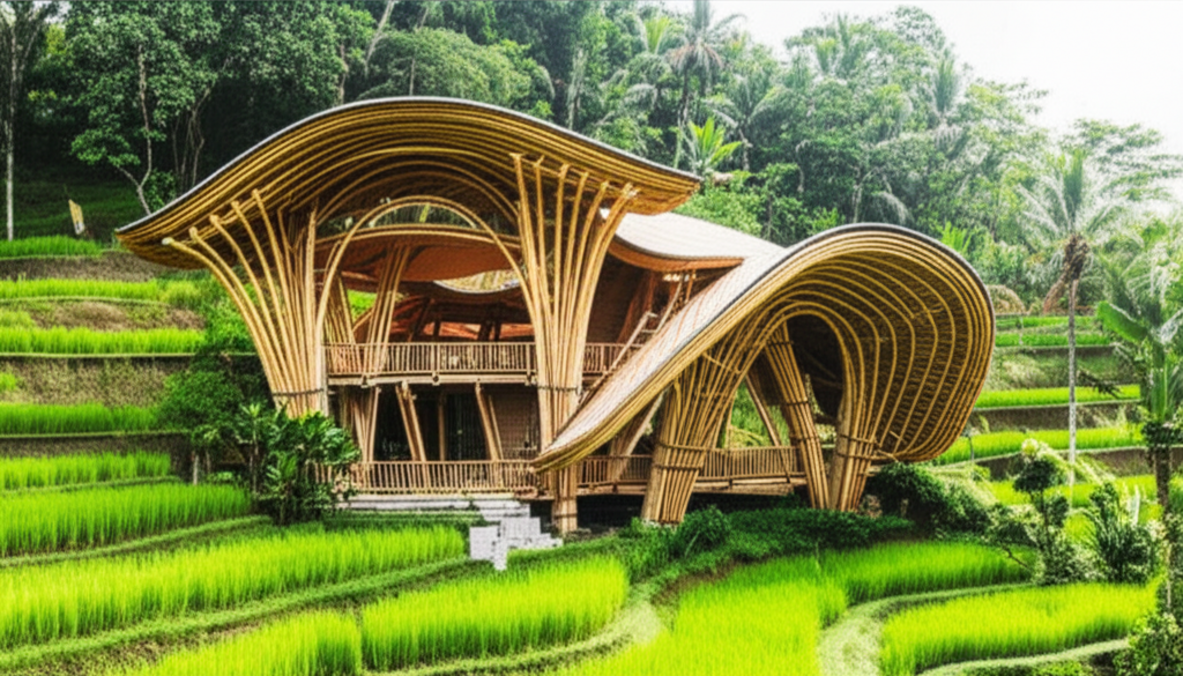
Prominent examples of bamboo’s innovative application can be seen across Bali. The Green School Bali stands as a world-renowned testament to bamboo’s potential, showcasing its breathtaking architectural beauty and intricate designs. Structures like “The Heart of the School,” an awe-inspiring building constructed with thousands of bamboo poles, demonstrate the material’s capacity for large-scale, complex designs.
Similarly, the design firm IBUKU, founded by Elora Hardy, has pioneered the use of bamboo in numerous projects, pushing the boundaries of what’s possible with this versatile material. IBUKU’s work, including luxurious villas and intricate public spaces, highlights how bamboo can be shaped into elegant curves, soaring arches, and detailed structural elements. Bamboo is now expertly utilized in foundations, often combined with concrete for stability, as the primary material for structural frames, creating open and airy spaces. It forms elegant roofing structures and is intricately woven into unique design elements, providing both aesthetic appeal and practical functionality. These innovative construction solutions Bali are not only aesthetically pleasing but also significantly contribute to sustainable building practices, paving the way for a more responsible and beautiful built environment on the island. For those looking to embark on such projects, partnering with an experienced general contractor in Bali is essential to navigate the unique aspects of bamboo construction. The ongoing development in bamboo architecture truly embodies the future of innovative construction in Bali.
The Rise of Bamboo Architecture as a Smart Solution
The urgent need for sustainable structures in Bali, driven by rapid development, has led to a remarkable resurgence in bamboo as a primary construction material. Far from being merely traditional, bamboo has emerged as a truly *smart solution* for innovative construction solutions in Bali, showcasing unparalleled environmental benefits and structural prowess. Its rapid growth rate, with some species maturing in as little as three to five years, makes it an endlessly renewable resource, significantly reducing reliance on slower-growing timber. Bamboo also acts as an exceptional carbon sink, sequestering more carbon dioxide than many trees, contributing significantly to mitigating the island’s carbon footprint. Its complete biodegradability at the end of its life ensures minimal environmental impact, a critical consideration for Bali’s delicate ecosystem and waste management challenges.
Beyond its ecological credentials, bamboo boasts impressive structural advantages ideal for the tropical climate and seismic activity common in the region. With a high strength-to-weight ratio, comparable to steel, and remarkable flexibility, bamboo structures exhibit inherent earthquake resistance, swaying with tremors rather than fracturing. This intrinsic resilience offers a natural safeguard in a tectonically active zone. Modern application, however, hinges on overcoming traditional limitations of durability against pests and moisture. Advanced treatment techniques, primarily through borax and other natural salt solutions, render bamboo immune to insects and rot, extending its lifespan to decades and establishing it as a high-performance material for innovative construction in Bali. Implementing such solutions effectively demands the expertise of premier general contractors in Bali.
Pioneering this architectural revolution are institutions like the *Green School Bali* and design firms such as *IBUKU*. The Green School stands as a living testament to bamboo’s potential, with its entire campus, including multi-story buildings, crafted almost exclusively from this versatile grass. These structures are not only breathtaking in their organic forms and intricate designs, showcasing bamboo’s aesthetic beauty and versatility, but also serve as educational models for sustainable living. IBUKU continues to push the boundaries of bamboo architecture, creating stunning homes, resorts, and public spaces that blend seamlessly with Bali’s natural landscape. Their projects exemplify how bamboo can be shaped into complex geometries and sweeping curves challenging with conventional materials.
Specific applications demonstrate bamboo’s broad utility. For foundations, while not replacing concrete for deep structural elements, bamboo can be integrated into lighter footing systems or used as robust formwork. Its primary strength shines in structural frames, where bundled or laminated culms create strong beams, columns, and trusses. Roofing designs often feature intricately woven bamboo mats or split bamboo sections, providing natural ventilation and aesthetic appeal, sometimes layered with other natural materials for enhanced weather protection. Moreover, bamboo is a master of intricate design elements, from detailed wall coverings and flooring to bespoke furniture and elegant staircases, proving its capacity for both structural integrity and exquisite interior finishes. The fusion of traditional Balinese craftsmanship with modern engineering allows for build and design services in Bali to create truly unique and sustainable properties, necessitating careful construction management in Bali to ensure quality and adherence to sustainable principles.
Embracing Sustainable Materials Beyond Bamboo
Beyond the singular elegance and versatility of bamboo, Bali’s commitment to sustainable construction extends to a rich tapestry of other innovative and naturally abundant materials. Builders and designers across the island are increasingly looking inwards, leveraging indigenous resources and upcycling waste streams to craft structures that are both environmentally responsible and deeply rooted in the local aesthetic. This approach not only reduces ecological impact but also fosters a unique architectural identity that speaks to Bali’s natural beauty and cultural heritage.
One significant shift involves the sophisticated use of locally sourced natural materials. Volcanic stone, readily available from the island’s geological formations, is a prime example. Its inherent thermal mass provides excellent insulation, keeping interiors cool in Bali’s tropical climate without heavy reliance on air conditioning. Beyond its functional benefits, volcanic stone offers a robust, earthy aesthetic that blends seamlessly with the island’s landscape, creating durable and visually striking foundations, walls, and decorative elements. Reclaimed timber, salvaged from old Javanese joglos, abandoned fishing boats, or dismantled structures, is another invaluable resource. Its weathered character tells a story, imbuing new buildings with a sense of history and warmth. By repurposing timber, the demand for newly felled wood is diminished, directly contributing to the preservation of Indonesia’s vital rainforests and supporting a circular economy within the local construction sector. Furthermore, compacted earth, often seen in the form of rammed earth or adobe, is experiencing a resurgence. These techniques utilize local soil, often mixed with natural stabilizers, to create thick, breathable walls with exceptional thermal regulation properties. They contribute to a healthy indoor environment by regulating humidity and temperature naturally, all while showcasing the raw, textural beauty of the earth itself.
The ingenuity doesn’t stop at nature’s bounty; Bali is also at the forefront of integrating recycled materials into its building lexicon. The island’s ongoing challenge with plastic waste is being ingeniously addressed by converting discarded plastics into valuable building components. Innovations include transforming plastic bottles into eco-bricks for non-load-bearing walls, or shredding and compressing various plastic wastes into durable panels and insulation materials. Similarly, recycled glass, often crushed and used as an aggregate in concrete or terrazzo, adds a sparkling, unique finish while diverting waste from landfills. Industrial by-products, such as fly ash from power plants, are increasingly being incorporated into concrete mixes, reducing the cement content and thereby significantly lowering the embodied carbon of the concrete. These innovative construction solutions in Bali not only reduce the carbon footprint associated with material production and transportation but also create new industries, generate local employment, and provide unique aesthetic and functional properties that distinguish Balinese architecture. For instance, several boutique hotels and private villas across Ubud and Canggu are pioneering these mixed-material approaches, showcasing structures with striking volcanic stone bases, walls inlaid with reclaimed wood, and playful accents of recycled glass, all masterfully integrated by experienced design and build services to create truly eco-conscious and visually captivating spaces. This thoughtful curation of materials moves beyond a single sustainable element, embracing a holistic view of resourcefulness and environmental stewardship.
Green Building Principles and Design Innovations
Smart Solutions: Innovative Construction Solutions in Bali delves deep into the foundational principles that shape truly sustainable development on the island. Moving beyond material selection, a crucial aspect of these innovative construction solutions in Bali is the intelligent application of green building principles and design strategies. These approaches are meticulously crafted to work harmoniously with Bali’s tropical climate, ensuring buildings are not just aesthetically pleasing but also inherently efficient and ecologically responsible.
A primary focus in Balinese sustainable construction is *passive design techniques*. These ingenious methods are employed to maximize natural ventilation and lighting, drastically minimizing the reliance on artificial cooling and heating systems, which in turn reduces energy consumption and operational costs. Strategic building orientation is paramount; structures are carefully positioned to leverage prevailing breezes for cross-ventilation and to control solar gain. Thoughtful implementation of shading devices, such as deep overhangs, trellises, and living green screens, protects interiors from the intense tropical sun while still allowing diffused natural light to penetrate. Open-plan layouts are frequently adopted, promoting unobstructed airflow throughout the living spaces and fostering a continuous connection with the outdoor environment. These design choices enhance comfort for occupants by maintaining a cooler, brighter interior without the constant drain of air conditioning.
Beyond climate-responsive architecture, *integrated water management systems* are a cornerstone of eco-conscious building in Bali. Rainwater harvesting is widely implemented, capturing the abundant rainfall for use in irrigation, flushing toilets, and even for domestic use after proper filtration. Greywater recycling systems, which treat water from sinks, showers, and laundry, are increasingly common, significantly reducing the demand for fresh water. Advanced, efficient wastewater treatment facilities are also integrated on-site, ensuring that discharged water has minimal environmental impact. These systems collectively champion water conservation, easing the burden on local water resources and reducing utility expenses.
Furthermore, permaculture principles are being seamlessly incorporated into landscape design around these structures, fostering self-sustaining environments. This involves the strategic planting of native, drought-resistant flora, edible gardens that provide food and medicinal plants, and the creation of biodiverse habitats that support local ecosystems. Such landscape designs not only contribute to the aesthetic appeal but also reduce maintenance needs, minimize water usage for irrigation, and help regulate microclimates around buildings. By integrating these principles, projects promote a holistic ecological balance, transforming properties into thriving, interconnected ecosystems. This thoughtful blend of passive design, water management, and permaculture represents the forefront of sustainable design services in Bali, promising enhanced comfort, substantially reduced operational costs, and a profound commitment to ecological stewardship. These endeavors are paving the way for innovative construction solutions in Bali that truly embody responsibility and foresight. For more information on creating such sustainable properties, consider exploring resources on sustainable structures Bali, especially when looking for a general contractor in Bali experienced in comprehensive solutions.
Integrating Smart Technologies in Balinese Builds
Bali’s construction landscape is rapidly evolving, embracing smart technologies to propel its journey toward truly sustainable and innovative structures. This shift extends beyond passive design, incorporating active systems that redefine energy independence and operational efficiency. A cornerstone of this advancement lies in the widespread adoption of renewable energy systems. Solar photovoltaic panels are increasingly common on rooftops, harnessing Bali’s abundant sunshine for clean electricity, significantly reducing reliance on conventional power grids and minimizing carbon footprints. Beyond solar, innovative approaches like the Green School’s “hydroelectric vortex” demonstrate potential for localized, small-scale renewable energy generation, tapping into Bali’s natural waterways. Such initiatives foster energy independence and contribute to a decentralized energy infrastructure, bolstering resilience against power fluctuations and promoting a more sustainable energy future for the island’s innovative construction.
Complementing these energy generation systems, smart home automation is revolutionizing how buildings interact with occupants and the environment. These intelligent systems allow for optimized energy consumption through automated lighting and appliance controls, ensuring resources are utilized efficiently. Advanced climate control, integrated with sensors, adapts to real-time weather conditions, maintaining optimal indoor comfort while minimizing energy waste. Furthermore, smart security features, from integrated CCTV to smart locks, enhance safety and peace of mind. These automation solutions elevate functionality and comfort, creating highly efficient and responsive living spaces. They empower owners with greater control, leading to substantial operational cost reductions and a smaller environmental impact.
The back end of modern construction also sees significant advancements through digital tools. Building Information Modeling (BIM) is rapidly becoming an indispensable platform, transforming the entire lifecycle of a project. BIM creates a comprehensive 3D digital representation, allowing architects, engineers, and builders in Bali to collaborate seamlessly, detect clashes early, and visualize the structure. This digital approach drastically improves efficiency, reduces material waste, and streamlines masterful building project management in Bali. Other digital tools, such as drone surveys, further enhance precision and coordination, proving instrumental in reducing costly errors and optimizing resource allocation, thereby contributing to smart construction cost management in Bali.
Ultimately, integrating these smart technologies—from renewable energy to automation and digital planning—equips buildings with enhanced resilience and responsiveness to dynamic conditions, ensuring longevity and adaptability in Bali’s unique tropical climate. This approach is fundamental to shaping the island’s architectural future, creating structures that are intelligent, efficient, and harmoniously integrated.
Community and Cultural Integration in Modern Construction
While the integration of smart technologies in Balinese builds marks a significant leap towards efficiency and sustainability, the true genius of innovative construction solutions in Bali lies in its profound respect for cultural values and unwavering community engagement. This approach moves beyond mere technological advancements, embedding each project within the rich social and spiritual tapestry of the island. Central to this philosophy is Tri Hita Karana, the Balinese life principle emphasizing harmony among God, humanity, and nature. This philosophy doesn’t just guide spiritual life; it fundamentally shapes architectural design and construction practices, ensuring that new developments are not just structurally sound but also spiritually aligned and socially responsible.
Modern construction in Bali consciously honors traditional architectural elements and craftsmanship. Builders and designers carefully adapt features like intricate carvings, open-plan layouts that embrace natural ventilation, and the strategic placement of structures according to Balinese spatial principles. This isn’t a mere aesthetic choice; it’s about maintaining a tangible connection to the island’s heritage. Projects frequently involve local artisans, whose expertise in working with natural materials such as bamboo, timber, and volcanic stone is invaluable. This direct engagement provides crucial economic opportunities for Balinese communities and plays a vital role in preserving indigenous knowledge and traditional building techniques. These craftsmen are not just labor; they are custodians of cultural wisdom, ensuring that the spirit of Bali is woven into every beam and stone. This collaborative spirit defines the best construction solutions Bali offers, emphasizing holistic development.
Initiatives focused on fostering community cohesion are paramount. New developments are often designed to integrate seamlessly with existing village structures, respecting local customs and ensuring that the economic benefits of construction circulate within the community. This often involves discussions with local leaders and residents during the planning stages, creating a sense of shared ownership and reducing potential social friction. Furthermore, many projects prioritize local workforce development, offering training in both traditional and modern construction techniques. This knowledge transfer empowers Balinese workers, enhancing their skills and providing long-term employment prospects beyond the immediate project. The goal is to build not just structures, but also capacity and prosperity within the local populace. This commitment to local talent is a hallmark of responsible construction in Bali, ensuring projects are sustainable in every sense. Such careful construction management in Bali ensures that cultural values are upheld alongside modern innovations, creating a unique paradigm for sustainable development that respects both the land and its people. For those looking to embark on such projects, finding a reputable general contractor in Bali who understands and champions these integrated approaches is crucial.
The Future of Innovative Construction in Bali
The trajectory of construction in Bali is undeniably geared towards a future where innovation and sustainability are not just buzzwords, but the very pillars of development. Looking ahead, the island is poised to further cement its reputation as a hub for innovative construction in Bali, with a sharpened focus on eco-friendly designs and advanced techniques. We foresee a continued evolution in bamboo architecture, moving beyond aesthetic appeal to integrate sophisticated engineering and treatment processes that enhance durability and fire resistance, truly unlocking its potential as a prime structural material for tropical environments. This evolution will be complemented by a significant diversification of sustainable materials. Expect to see an increased adoption of locally sourced recycled aggregates, engineered timber from sustainably managed forests, and bio-based composites that offer both performance and a reduced environmental footprint. The emphasis will shift towards a circular economy model within construction solutions Bali, where waste is minimized, and materials are reused or recycled throughout their lifecycle.
The increasing adoption of smart technologies will fundamentally transform how buildings are designed, constructed, and operated. Imagine structures equipped with integrated energy management systems that optimize power consumption based on occupancy and weather patterns, smart irrigation systems that conserve water, and advanced climate control mechanisms that leverage natural ventilation and passive cooling techniques. These intelligent solutions will be seamlessly woven into green design principles, emphasizing not just energy efficiency but also water conservation through rainwater harvesting and greywater recycling, and the integration of renewable energy sources like solar power. Projects will increasingly prioritize designs that blend with Bali’s natural landscape, promoting biodiversity and minimizing ecological disruption. This holistic approach to sustainable structures Bali will see buildings not just coexisting with nature, but actively contributing to its preservation.
Bali’s unique cultural heritage, coupled with its increasing commitment to environmental stewardship, positions it to become a global leader and an exemplary model for sustainable, culturally sensitive development in tropical regions. The vision for Bali’s future infrastructure is one where every new build, every renovation, and every urban planning decision is made with ecological integrity and long-term economic prosperity in mind. Smart Solutions for sustainable building will continue to shape the island, creating resilient, resource-efficient, and aesthetically pleasing environments that enhance the quality of life for residents and visitors alike, ensuring that the island’s natural beauty and cultural richness are preserved for generations to come. This forward-thinking approach will solidify Bali’s role as a beacon of responsible and innovative development in a rapidly changing world.
Conclusions
The journey through Bali’s innovative construction landscape reveals a profound commitment to sustainability and cultural preservation. From the ingenious use of bamboo in architectural marvels to the integration of smart technologies and green design principles, Bali is setting a precedent for responsible development. These ‘Smart Solutions’ not only address the environmental challenges of a growing island but also celebrate its rich heritage. By embracing innovation while honoring tradition, Bali is building a future where progress harmonizes with nature and community.