Table of Contents
- Understanding the Bali Construction Landscape
- Core Principles of Project Management for Bali Builders
- Navigating Regulations and Permits in Bali
- Supply Chain and Resource Management on the Island
- Risk Management and Quality Control for Bali Projects
- Technology and Innovation in Bali Project Management
- Conclusions
Welcome to the dynamic world of construction in Bali! This article delves into the essential strategies and practices for effective project management for builders in Bali. We will explore how to navigate the island’s distinctive challenges and capitalize on its unique opportunities, ensuring your construction projects are not just successful, but also sustainable and integrated within the local context. Learn to Build Smarter, making your ventures thrive amidst Bali’s vibrant landscape.
Understanding the Bali Construction Landscape
Understanding the Bali construction landscape requires a nuanced perspective, far beyond standard building practices found elsewhere. The island’s unique characteristics fundamentally shape every project, from luxury villas to boutique resorts and vital commercial developments. Builders must navigate a distinctive regulatory environment, exemplified by the navigating the PBG process for building in Bali, which replaces previous permits and demands strict adherence to local zoning and environmental impact assessments.
Environmental considerations are paramount. Bali’s tropical climate presents challenges such as intense humidity, heavy rainfall, and prolonged sun exposure, requiring materials and construction methods that withstand these elements. Furthermore, the region’s seismic activity necessitates robust structural engineering, making building strong in Bali with appropriate foundation technologies crucial for enduring properties. An increasing focus on sustainability also drives the adoption of eco-friendly practices, creating a demand for sustainable structures Bali that blend seamlessly with the natural environment.
Cultural influences deeply embed themselves in Balinese architecture. Projects often require a delicate balance between traditional aesthetics, emphasizing harmony with nature and Hindu philosophies, and modern functionality. The integration of local materials like wood, bamboo, and stone is common, reflecting the art of Bali building. Builders face common challenges, including the complexities of land acquisition, particularly understanding freehold versus leasehold, and potential infrastructure limitations. The dynamics of local labor, with its own unique skill sets and cultural nuances, also demand careful management. Whether constructing opulent private residences or bustling commercial hubs, comprehending these multifaceted aspects is essential for successful project management for builders in Bali.
Core Principles of Project Management for Bali Builders
Core Principles of Project Management for Bali Builders
Effective project management for builders in Bali transcends universal principles by meticulously integrating them with the island’s unique operational nuances. The cornerstone is comprehensive project planning. This isn’t merely drawing up a timeline; it involves a deep dive into every facet of a build, from preliminary designs to final touches. Meticulous scope definition is critical, ensuring all stakeholders—clients, architects, local artisans, and regulatory bodies—share an identical vision of the project’s deliverables. Ambiguity here can lead to significant cost overruns and delays in a dynamic environment like Bali.
Realistic scheduling is paramount. While tools like Gantt charts and the Critical Path Method (CPM) provide a robust framework, they must be adapted to local realities. This means accounting for Balinese holidays such as Nyepi, which can halt all activity, and factoring in extended material import times, especially for specialized components not readily available on the island. Flexibility within a rigid schedule is key to navigating unforeseen circumstances. For more on optimizing timelines, explore construction project schedules in Bali.
Budgeting strategies must be equally agile, anticipating fluctuating material costs—influenced by global markets and import logistics—alongside nuanced local labor rates and potential import duties. A robust budget includes contingencies for unexpected challenges. For insights into managing construction costs, see your guide to project costs in Bali. Efficient resource allocation is twofold: human and material. This involves strategically deploying both skilled local labor and expatriate expertise, recognizing the strengths and cultural practices of each. Material resources demand careful procurement and storage, given the tropical climate and potential for supply chain disruptions.
Crucially, clear and cross-cultural communication is the bedrock of successful construction and project management in Bali. This extends beyond language, embracing local customs (adat) and fostering strong relationships with local teams, suppliers, and community leaders (banjar). Effective stakeholder management ensures all parties are informed and engaged, mitigating potential conflicts. The standard project management phases—initiation, planning, execution, monitoring & controlling, and closure—are applied rigorously, but with an inherent understanding of Bali’s distinct environment. From the initial conceptualization to the final handover, each phase requires a cultural sensitivity that transforms standard practices into a uniquely Balinese approach, ensuring projects are not just built, but harmoniously integrated. For deeper insights into managing your entire build, consider how expert general contractor project management can elevate your construction experience.
Navigating Regulations and Permits in Bali
The landscape of construction permits in Bali has significantly evolved, transitioning from the traditional IMB (Izin Mendirikan Bangunan) to the current PBG (Persetujuan Bangunan Gedung) under Indonesia’s Omnibus Law (UU Cipta Kerja). This shift necessitates a refined approach to obtaining legal authorization for any building project. Securing a PBG involves a multi-layered approval process, commencing with a detailed submission of architectural plans that adhere to local design aesthetics and structural integrity standards.
This includes meticulous calculations and drawings ensuring the building’s stability, particularly crucial in Bali’s seismic region. Furthermore, environmental considerations are paramount, requiring specific approvals detailing how the project will minimize its ecological footprint. For a comprehensive overview, refer to our guide on navigating the PBG process for building in Bali.
Beyond the PBG, builders must meticulously navigate Bali’s intricate land use laws and zoning regulations, uniquely tailored to preserve the island’s natural beauty and cultural heritage. Critical aspects include adherence to *green belt* designations, where construction is severely restricted or prohibited to protect agricultural land and natural landscapes. *Height restrictions* are strictly enforced, often limiting buildings to a maximum of four stories or below the coconut tree line, a rule steeped in both aesthetic and spiritual reverence. Additionally, *setback distances* from property lines, rivers, and the coastline are rigorously applied to ensure proper infrastructure, accessibility, and environmental protection. Understanding these nuances is crucial for any build and design services in Bali.
For larger projects, an *Environmental Impact Assessment* (EIA), known as AMDAL (Analisis Mengenai Dampak Lingkungan), is mandatory, while smaller-scale developments typically require a UKL-UPL (Upaya Pengelolaan Lingkungan Hidup dan Upaya Pemantauan Lingkungan Hidup). These assessments ensure sustainable development and mitigate potential negative impacts on Bali’s delicate ecosystem. Beyond legal adherence, fostering community acceptance is crucial. Engaging respectfully with local customs (*adat*) and effectively communicating with *banjar* (local community council) leaders is indispensable. The *banjar* plays a pivotal role in local governance, and their endorsement can significantly smooth project progression, preventing delays rooted in social disharmony. Building strong relationships and understanding community needs ensures a socially responsible and smoothly executed project. This critical aspect, alongside detailed residential construction project management in Bali, ensures a truly integrated approach, from initial design to construction quality control in Bali. Partnering with general construction contractors in Bali who comprehend these local intricacies is key to overall success.
Supply Chain and Resource Management on the Island
Effective project management for builders in Bali heavily relies on astute supply chain and resource management. The island’s unique setting presents distinct challenges and opportunities. Sourcing materials demands a strategic approach, differentiating between readily available local resources and essential international imports. Bali provides natural materials like volcanic stone, various hardwoods, and river sand. Utilizing these supports local economies, aligns with aesthetics, and often offers cost advantages by reducing transportation. However, meticulous quality control and consistent supply verification for local items are crucial. For specialized fittings, advanced machinery, or unique finishes not found locally, international importation becomes necessary. This introduces significant logistical hurdles, including extended lead times, complex customs, duties, and securing reliable island transport. Builders must meticulously plan these aspects, factoring potential delays and costs, to maintain project schedules and budgets.
Labor management is equally critical, requiring cultural sensitivity and practical expertise. Integrating the local workforce is fundamental, fostering community engagement and leveraging indigenous building knowledge. Addressing skilled labor availability often involves on-site training or collaborating with vocational programs to upskill local workers, ensuring high craftsmanship. For highly specialized roles, expatriate expertise may be needed. This demands navigating specific visa and work permit regulations, which can be complex, and managing higher associated costs, emphasizing the need for smart construction cost management. A skilled general contractor in Bali understands both local and international labor dynamics for a harmonious work environment.
Furthermore, construction projects in Bali must prioritize sustainable sourcing and robust waste management. Given the island’s fragile ecosystem, minimizing the environmental footprint is a crucial responsibility. This involves prioritizing locally sourced, responsibly harvested materials whenever feasible. Implementing effective on-site waste management is essential, including thorough segregation (e.g., organic, plastics, metals, construction debris), promoting recycling, and ensuring responsible disposal to minimize landfill impact. Collaborating with local communities and waste services for appropriate recycling and disposal is vital for reducing environmental impact and contributing to a more sustainable future for Bali. Embracing these practices is key to sustainable design and construction on the island.
Risk Management and Quality Control for Bali Projects
Risk Management and Quality Control for Bali Projects
Building smarter in Bali necessitates a robust approach to risk management and stringent quality control, specifically tailored to the island’s unique environment. Identifying potential risks begins with understanding the specific challenges. Adverse weather events are a primary concern; Bali experiences intense wet seasons that can lead to significant construction delays, site accessibility issues, and potential damage if not properly mitigated. While less frequent, the region’s seismic activity demands particular attention to structural design and construction methods. Cultural misunderstandings also pose a risk; navigating local customs, communication nuances, and traditional work practices is crucial for harmonious project execution. Engaging a reliable Bali project contractor who understands these cultural dynamics can significantly reduce friction. Material procurement, despite diligent supply chain management, still carries the risk of unexpected delays due to customs, shipping logistics, or local availability fluctuations. Furthermore, changes in local regulations or the political landscape can impact permits, timelines, and even project feasibility.
Assessing the impact of these risks involves evaluating their potential effect on schedule, budget, and project quality. Proactive mitigation plans are then developed. For weather-related risks, this includes implementing flexible scheduling, using temporary shelters, and installing effective drainage systems. To counter cultural misunderstandings, cross-cultural training for expatriate staff and employing local project managers or liaisons who can bridge communication gaps are invaluable. For potential material delays, maintaining contingency stock for critical items and fostering strong relationships with multiple local and international suppliers are key. Staying updated on local governmental changes and incorporating legal counsel from the outset helps navigate regulatory shifts. This comprehensive foresight is a cornerstone of effective contractor project management in Bali.
Robust quality control is paramount to delivering high-quality builds that meet client expectations and withstand Bali’s tropical conditions. This starts with meticulous material inspections; both locally sourced materials like specific timber and stone, and imported items such as specialized fittings, must undergo thorough checks to ensure they meet specified quality standards and are free from defects. Workmanship standards must adhere to both international benchmarks for structural integrity and local aesthetic requirements, ensuring that the finished product not only lasts but also harmonizes with Bali’s architectural ethos. Strict adherence to design specifications is non-negotiable, requiring detailed blueprints and consistent supervision. Regular site inspections, often daily by site supervisors and weekly by project managers, are vital for continuous monitoring. Independent quality audits offer an unbiased assessment, catching potential issues early and validating compliance. Clear and comprehensive documentation of all inspections, material tests, and design revisions is critical for accountability and ensuring construction quality control in Bali, ultimately contributing to smarter builds and effective construction management in Bali. This meticulous process ensures that projects embody the art of luxury high-end residential construction in Bali, built to last.
Technology and Innovation in Bali Project Management
Modern technology and innovative approaches are indispensable for builders in Bali striving to ‘Build Smarter.’ The adoption of sophisticated project management software solutions significantly enhances operational efficiency across scheduling, budgeting, and collaboration, especially pertinent for managing geographically dispersed teams that often characterize construction in Bali. These cloud-based platforms offer real-time visibility into project timelines through interactive Gantt charts, facilitate precise budget tracking by integrating financial data, and streamline document management, ensuring all stakeholders, from architects in Europe to local suppliers, work with the most current information. Such tools are critical for fostering seamless contractor project management in Bali, allowing for proactive adjustments and preventing costly delays.
Beyond administrative oversight, Building Information Modeling (BIM) stands as a transformative technology for collaborative design and construction. BIM creates a comprehensive digital representation of a project, integrating architectural, structural, and mechanical, electrical, and plumbing (MEP) data into a single, intelligent 3D model. This enables early and accurate clash detection, identifying potential conflicts between different building systems before physical construction begins, thereby reducing errors and rework on-site. The visual clarity provided by BIM also aids in project visualization, allowing clients and teams to better understand the design intent and make informed decisions, improving overall efficiency from conceptualization through to execution. It’s an essential component for any firm aiming for smarter construction management in Bali.
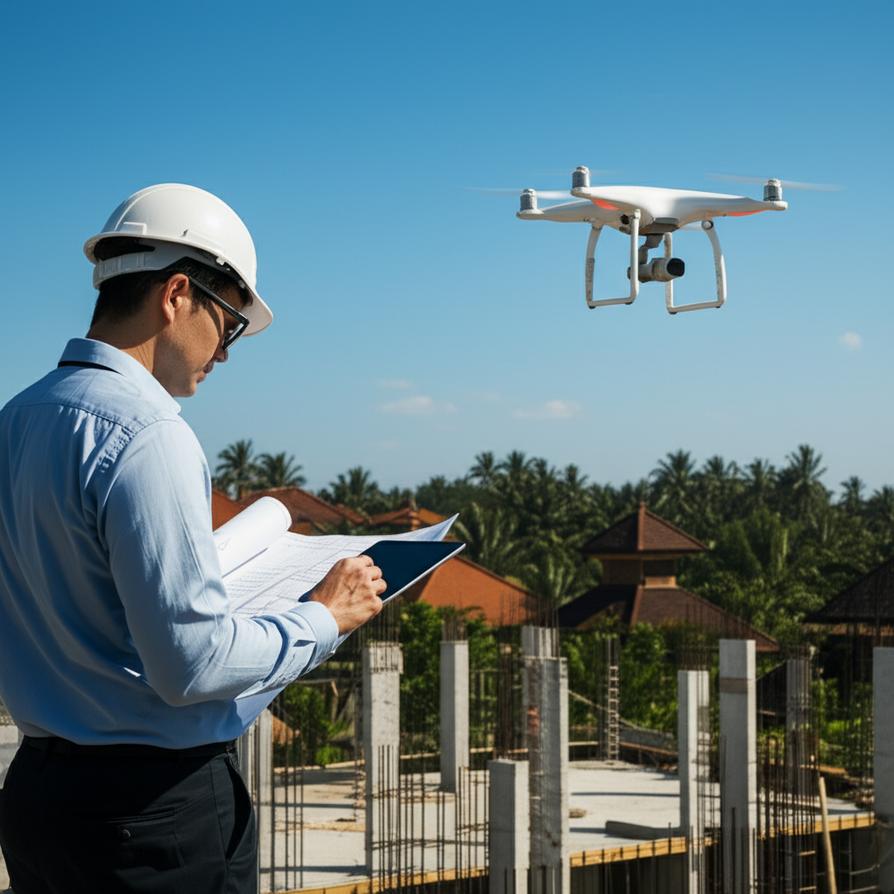
Furthermore, drones have revolutionized site monitoring and progress tracking in Bali’s diverse and sometimes challenging terrains. Equipped with high-resolution cameras and mapping capabilities, drones conduct rapid topographic surveys, generate accurate site maps, and perform regular aerial inspections. This provides invaluable data for assessing site conditions, monitoring earthworks, and tracking construction progress against the schedule, offering a bird’s-eye view that traditional methods cannot match. Drones also enable safer inspections of tall structures or inaccessible areas, contributing to enhanced safety protocols.
Finally, effective digital communication tools are paramount for bridging geographical distances and cultural barriers within Bali’s unique construction landscape. Platforms for instant messaging, video conferencing, and shared workspaces ensure continuous and transparent information flow among project teams, architects, engineers, and stakeholders. This immediacy facilitates quicker decision-making and fosters a stronger sense of team cohesion, which is vital for any expert general contractor project management, ensuring all parties remain aligned with project goals and fostering mutual understanding in a multicultural environment. These tools empower builders to react swiftly to challenges and capitalize on opportunities, thereby optimizing every phase of their Bali construction projects.
Conclusions
Mastering project management for builders in Bali is key to transforming challenges into successes. By embracing localized strategies, navigating regulations diligently, and leveraging modern technologies, builders can achieve efficient, high-quality, and culturally sensitive outcomes. Remember, smart construction in Bali is about more than just building structures; it’s about creating enduring value within a unique and beautiful environment. Adopt these principles to truly Build Smarter on the Island of Gods.