Table of Contents
- The Imperative for Innovation in Balinese Construction
- Harnessing Nature’s Bounty Local Materials and Traditional Wisdom
- Eco-Friendly Design Principles and Smart Technologies
- Building Resilience Innovative Approaches to Disaster-Resistant Structures
- The Future Landscape of Bali’s Built Environment
- Conclusions
Bali, known for its breathtaking natural beauty and rich cultural heritage, is rapidly becoming a hub for innovative construction. As the island faces increasing development, there’s a growing imperative to embrace sustainable building practices that respect its delicate ecosystem and vibrant traditions. This article delves into the cutting-edge trends and pioneering projects shaping the future of architecture in Bali, showcasing how builders are harmonizing modern needs with environmental stewardship.
The Imperative for Innovation in Balinese Construction
Bali, often revered as the Island of Gods, is a place where breathtaking natural beauty meets a vibrant cultural tapestry. Yet, beneath this idyllic surface, the island faces an increasingly urgent demand for innovation within its construction sector. The foundational reasons for this imperative are multifaceted, stemming from acute environmental pressures, the profound cultural significance of its landscapes and traditions, and the relentless pace of tourism-driven expansion. These factors collectively underscore the critical need for innovative construction Bali, a paradigm shift towards practices that are both sustainable and forward-thinking.
One of the most pressing drivers for change is the mounting environmental challenge. Conventional building methods, heavily reliant on finite resources like river sand, aggregates, and traditional timber, are rapidly depleting Bali’s natural capital. The extraction of these materials often leads to ecological degradation, impacting river systems, coastlines, and forests. Furthermore, the construction industry traditionally generates substantial waste, much of which ends up in overstressed landfill sites, contaminating soil and water and marring the island’s pristine landscapes. The carbon footprint associated with transporting materials and energy-intensive construction processes also contributes significantly to environmental strain, challenging Bali’s delicate ecological balance. It’s clear that the current trajectory is unsustainable, necessitating a radical rethinking of how we build on this precious island.
Beyond environmental concerns, there is a deep cultural imperative to integrate sustainable practices with traditional Balinese aesthetics and community values. Balinese architecture is not merely about structures; it is an embodiment of the philosophy of Tri Hita Karana – harmony between humans, nature, and the divine. This translates into designs that respect the environment, utilize local materials harmoniously, and foster a sense of community. Any innovation in construction must honor this ancestral knowledge, ensuring that new developments do not alienate from the island’s unique architectural language or disrupt the social fabric of its villages. Thoughtless expansion risks eroding the very essence of Balinese charm and identity. Therefore, innovation must be a thoughtful dialogue between tradition and modernity, fostering culturally resonant designs that respect sustainable design in Bali.
The rapid growth of tourism further intensifies the need for smarter, more resilient building solutions. As millions flock to Bali each year, the demand for accommodation, infrastructure, and commercial spaces skyrockets. This rapid development, if unchecked, can overwhelm existing resources and infrastructure, leading to urban sprawl, increased traffic, and further environmental degradation. The imperative is not to halt growth, but to manage it intelligently, ensuring that new constructions are not only efficient and durable but also minimize their ecological impact and seamlessly integrate into the local context. This necessitates a proactive approach to project management for builders in Bali, focusing on long-term sustainability.
In response to these multifaceted pressures, the concept of ‘green’ building has emerged as a crucial solution. Green building encompasses a holistic approach to construction, from material sourcing and energy efficiency to waste reduction and water management. It prioritizes the use of renewable resources, passive design strategies that harness natural ventilation and lighting, and technologies that reduce operational costs and environmental impact. This approach is vital for crafting eco-friendly homes and resorts in Bali that stand as testaments to responsible development. Ultimately, the importance of thoughtful development cannot be overstated. By embracing innovative construction Bali, the island can accommodate its expansion while preserving its unique charm, natural heritage, and cultural integrity, laying a foundation for a truly sustainable future. This requires the expertise of general construction contractors in Bali who are committed to these principles.
Harnessing Nature’s Bounty Local Materials and Traditional Wisdom
Harnessing Nature’s Bounty Local Materials and Traditional Wisdom
The evolution of construction in Bali, propelled by an urgent need for sustainable practices as discussed in the previous chapter, is deeply rooted in the island’s abundant natural resources and time-honored building traditions. *Innovative construction Bali* is not merely about adopting cutting-edge technology, but fundamentally about redefining and revaluing indigenous materials and ancestral wisdom, creating structures that are both resilient and intrinsically Balinese. This approach offers a profound response to environmental challenges, blending cultural reverence with forward-thinking design to shape the island’s future.
At the forefront of this material renaissance is *bamboo architecture*. Far from its rustic perception, bamboo has emerged as a marvel of sustainable engineering, celebrated for its remarkable versatility, incredible strength, and unparalleled rapid renewability. This grass species grows to maturity in just a few years, making it an exceptionally sustainable alternative to conventional timber. Its natural flexibility allows for breathtaking organic forms and sweeping, curvilinear designs that are both structurally sound and visually captivating. Across Bali, bamboo is being ingeniously applied in a diverse range of structures, from intricate private villas and luxurious resorts to community buildings and educational facilities. Its high tensile strength, comparable to steel, enables architects to create expansive, open spaces without heavy conventional supports, while its lightweight nature simplifies construction logistics. The aesthetic appeal of bamboo is undeniable; its warm tones, intricate patterns, and natural texture evoke a deep connection to the island’s lush environment, creating harmonious living spaces. Modern treatment techniques, often involving natural borax solutions, ensure the longevity and durability of bamboo structures, protecting them from pests and moisture without harsh chemicals. This re-imagining of bamboo showcases how traditional materials can be elevated to meet contemporary architectural demands, contributing significantly to sustainable villa construction.
Complementing bamboo’s rise is the increasing adoption of *reclaimed and sustainably sourced timber*. The environmental benefits of using reclaimed wood are substantial, significantly reducing demand for newly harvested timber and diverting valuable materials from landfills. This practice lowers the carbon footprint associated with logging and processing new wood, aligning perfectly with Bali’s green building initiatives. Beyond its ecological advantages, reclaimed timber brings a unique character and history to any project. Each plank often carries a story, visible in its distinctive grain, natural imperfections, and rich patina developed over years. This allows for immense creative possibilities, offering textures and aesthetics that brand-new materials simply cannot replicate. From the weathered planks of old fishing boats transformed into striking wall claddings or bespoke furniture, to ancient teak beams salvaged from traditional Javanese houses finding new life as structural elements or intricate flooring, reclaimed timber adds depth, warmth, and a timeless elegance. Sustainably sourced timber, certified from responsibly managed forests, provides a crucial alternative for new wood requirements, ensuring that timber harvesting does not contribute to deforestation. For any general construction in Bali, prioritizing these timber sources demonstrates a commitment to environmental stewardship.
Furthermore, Bali’s rich volcanic geology provides an abundant supply of *natural stones and aggregates*, which are seamlessly integrated into innovative designs for both their inherent structural integrity and their powerful aesthetic connection to the Balinese landscape. Volcanic rocks like andesite and basalt, with their dark, earthy tones, are robust and durable, ideal for foundations, retaining walls, and feature elements. River stones, smoothed by centuries of water flow, are often used for decorative purposes, pathways, and stunning feature walls, bringing the texture of nature indoors. Coral stone, although softer and primarily used for decorative purposes, adds a unique porous texture and lightness to facades. These materials are not merely decorative; their thermal mass properties help regulate indoor temperatures, contributing to passive cooling strategies that minimize the need for artificial climate control. Traditional Balinese building techniques, which often involve skilled stone masonry and intricate carving, are revitalized and adapted to modern contexts, allowing these natural elements to ground contemporary structures firmly within their cultural and environmental context. Working with a skilled home contractor in Bali ensures that these materials are sourced and integrated effectively. This thoughtful integration of natural materials, coupled with a deep respect for traditional craftsmanship, defines a significant aspect of Bali’s innovative construction landscape, showcasing a pathway towards genuinely sustainable and culturally resonant architectural practices on the Island of Gods. This holistic approach is essential for any sustainable design project here.
Eco-Friendly Design Principles and Smart Technologies
Bali’s commitment to innovative construction Bali extends beyond material selection, embracing advanced eco-friendly design principles and smart technologies. Architects and builders now integrate features that drastically reduce environmental impact and enhance living quality, aligning with global sustainability goals.
A cornerstone is the sophisticated implementation of passive cooling and natural ventilation. In Bali’s warm and humid climate, minimizing reliance on energy-intensive air conditioning is paramount. Design strategies are integral to the blueprint: buildings are oriented for maximum cross-ventilation, capturing prevailing breezes. Strategic placement of windows, louvers, and open-air corridors ensures constant airflow, naturally dissipating heat. High ceilings, expansive overhangs, and open-plan layouts facilitate convection, allowing warm air to rise and escape. Courtyards and internal gardens create cooler microclimates, while careful consideration of thermal mass moderates indoor temperatures. These integrated elements maintain comfortable environments, significantly cutting electricity consumption and fostering healthier, natural living.
Complementing these passive strategies are robust rainwater harvesting and greywater recycling systems, vital for water conservation in an island environment. Rainwater from roofs is channeled into filtration systems and stored in cisterns, then utilized for non-potable purposes like irrigation, toilet flushing, and cleaning. This reduces reliance on municipal or well water. Greywater recycling treats wastewater from sinks, showers, and laundry, reusing it for landscaping. These closed-loop systems alleviate pressure on Bali’s water reserves and offer property owners substantial savings, enhancing self-sufficiency and environmental responsibility.
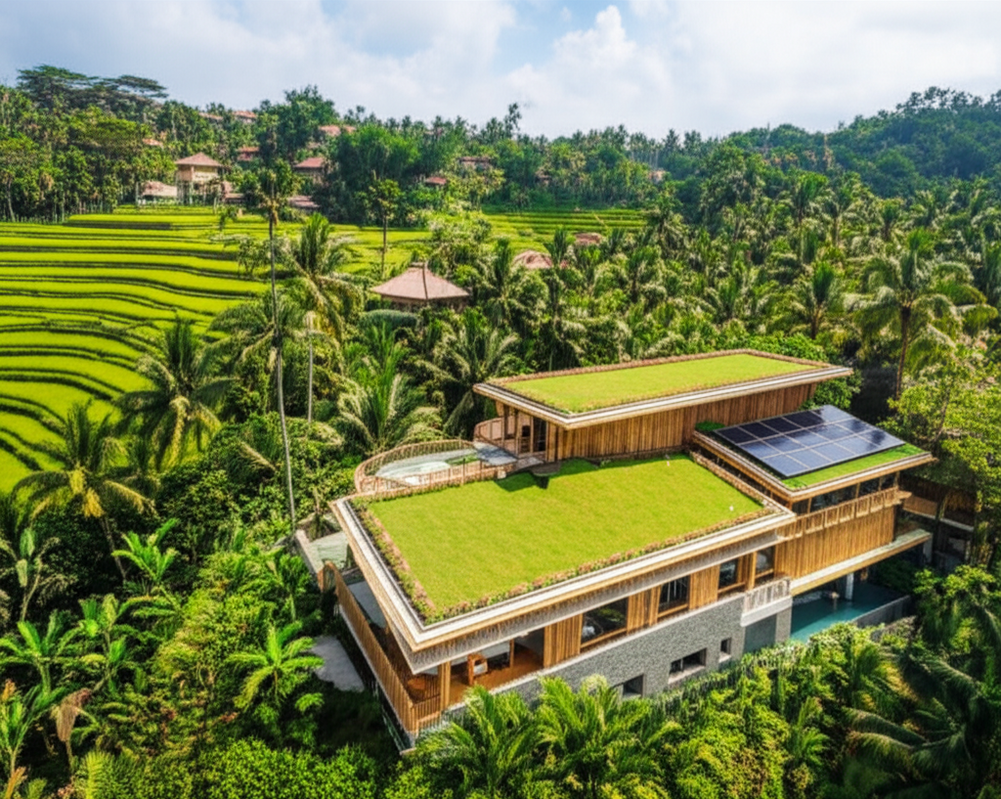
Furthermore, Bali’s abundant sunshine makes it ideal for solar energy integration. Photovoltaic (PV) panels are increasingly standard on new builds and renovations, converting sunlight into electricity. These can be grid-tied or operate off-grid with battery storage, providing energy independence. Solar water heaters efficiently provide hot water, reducing the need for electric or gas alternatives. This widespread adoption of renewables significantly lowers carbon footprints and advances Bali’s goal of reducing fossil fuel reliance. The synergy of these technologies helps properties approach net-zero energy consumption.
Effective waste management and recycling during construction are prioritized to minimize environmental impact. This involves a shift towards a circular economy approach. Meticulous pre-construction planning focuses on material optimization and waste reduction. On-site, waste is systematically sorted into categories like concrete, wood, metal, plastics, and cardboard. Partnerships with local recycling facilities ensure diversion from landfills. Usable materials are salvaged or donated, and organic waste is composted. This proactive approach minimizes the ecological footprint of construction in Bali and encourages a resource-efficient industry, reflecting smart construction management in Bali.
Finally, green roofs and vertical gardens offer both aesthetic and ecological benefits, transforming landscapes. These living installations, featuring vegetation on rooftops or facades, provide excellent thermal insulation, reducing heat gain and loss, thus lowering cooling and heating demands. They also manage stormwater by absorbing rainwater, lessening runoff. Aesthetically, they enhance biodiversity by creating new habitats, transforming structures into vibrant, natural extensions of the Balinese environment. These features beautify properties, improve air quality, and deepen the connection to nature, embodying a holistic approach to sustainable design in Bali. The integration of these advanced technologies and principles marks a significant step towards making buildings in Bali more self-sufficient, resilient, and harmonized with the island’s precious natural environment, showcasing how innovative construction is truly building tomorrow, today.
Building Resilience Innovative Approaches to Disaster-Resistant Structures
Building Resilience: Innovative Approaches to Disaster-Resistant Structures
Bali, an island of breathtaking beauty and vibrant culture, unfortunately lies within a region prone to natural phenomena such as seismic activity and tropical storms. The imperative for resilient structures is paramount, driving a significant push towards innovative construction Bali practices that address these inherent challenges head-on. Modern construction in Bali is no longer solely about aesthetics or functionality; it’s deeply rooted in ensuring the longevity and safety of buildings against the unpredictable forces of nature.
One of the most critical aspects of building resilience involves advanced structural engineering techniques for earthquake resistance. Given Bali’s proximity to active fault lines, structures must be designed to withstand seismic forces. This often involves employing reinforced concrete frames with meticulously calculated load paths and ductile detailing, allowing buildings to deform without catastrophic failure. Shear walls and moment-resisting frames are strategically integrated to absorb and dissipate earthquake energy. Furthermore, some cutting-edge projects are exploring base isolation systems or seismic dampers, though these are typically reserved for larger, high-value developments due to their complexity and cost. Adherence to increasingly stringent local building codes, often informed by international seismic design standards, ensures that every new development incorporates a foundational layer of earthquake readiness. The collaboration between experienced structural engineers and local general construction contractors in Bali is crucial in translating these complex designs into robust realities.
Beyond seismic concerns, the tropical climate brings its own set of challenges, primarily heavy rainfall and strong winds. Innovative construction Bali employs specific material choices and architectural designs that are engineered to withstand these conditions. High-quality, weather-resistant materials are chosen, including treated hardwoods for their natural durability and aesthetic appeal, and reinforced concrete augmented with waterproofing admixtures. Roofing is a particular focus, with steep pitches allowing for rapid water runoff and reinforced connections to the main structure to prevent uplift during high winds. Materials like corrugated steel or robust composite tiles, often chosen for their longevity, are securely fastened. Large roof overhangs, a common feature in traditional Balinese architecture, serve a dual purpose: they provide shade and protect wall surfaces from prolonged exposure to rain, minimizing moisture ingress and subsequent material degradation. Strategic placement of windows and doors with robust frames and secure locking mechanisms further enhances a building’s ability to resist strong gusts.
Addressing the threat of flooding, particularly in coastal or low-lying areas, has led to the adoption of flood-resistant foundations and elevated structures. Pile foundations are a preferred method, driving deep into the earth to provide stability and lift the building’s main habitable areas above potential flood levels. Stilt or raised platform designs, inspired by traditional housing in many flood-prone regions, are becoming increasingly common, especially for villas situated near rivers or the ocean. This not only mitigates flood damage but also improves natural ventilation beneath the structure, combating humidity. The selection of water-resistant materials for the lower sections of buildings, such as specific types of concrete or masonry, also plays a vital role. When considering professional foundation installers in Bali, it’s essential to seek those with expertise in these specialized resilient techniques.
The essence of building resilience in Bali lies in the harmonious blend of local knowledge and modern engineering. Traditional Balinese architectural principles, such as *Asta Kosala Kosali*, have always emphasized harmony with nature and considered the environmental context. Modern engineering integrates these timeless principles with scientific understanding of structural integrity and material science. This fusion results in buildings that are not only aesthetically pleasing and culturally resonant but also inherently safer and more sustainable. Local materials, when innovatively applied and properly engineered, offer sustainable and robust solutions. This forward-thinking approach to building in a dynamic environment ensures longevity and safety, contributing significantly to the overall goal of building with strength structural construction in Bali. The commitment to construction quality control in Bali throughout the entire process is key to achieving these resilient outcomes.
The Future Landscape of Bali’s Built Environment
The trajectory of innovative construction Bali envisions a future linking human ingenuity and environmental stewardship. The island embraces sustainable practices, moving beyond aesthetics to a holistic approach respecting its ecosystem and culture. Local, renewable resources like bamboo and reclaimed timber, with passive design for ventilation and lighting, set strong precedents. Renewable energy, such as solar panels and rainwater harvesting, demonstrates self-sufficiency, propelling Bali into a smart, regenerative future.
Smart home technologies hold immense potential for Bali’s built environment. Villas intelligently adjusting lighting and climate, optimizing energy without sacrificing comfort, are envisioned. Automation managing irrigation and security will enhance nature’s connection. This extends beyond individual homes to interconnected communities, where smart infrastructure supports efficient resource management. For such solutions, understanding general construction services in Bali is crucial.
Community-centric designs play a pivotal role. Balinese life is communal; future architecture will reflect this by fostering shared spaces, social interaction, and integrating local artisans. Creating interconnected hamlets honoring traditional layouts, with communal gathering areas and organic pathways, is key. Emphasis shifts towards environments nurturing wellbeing and social cohesion, moving from isolated structures to integrated living ecosystems. This philosophy is evident in residential construction in Bali prioritizing cultural harmony.
Circular economy principles are set to revolutionize construction, designing buildings for longevity, adaptability, and eventual deconstruction. Waste reduction is paramount, focusing on material reuse, recycling debris, and modular techniques. Projects will specify materials with low embodied energy and high recyclability, actively closing material loops. Innovative applications of salvaged materials will transform waste into valuable resources, reducing demand on virgin materials. Embracing these principles requires deep understanding of sustainable practices, a core focus for eco-friendly homes and resorts in Bali.
Balinese culture and the island’s unique spirit will continue to inspire architecture. The profound connection to nature, spiritual reverence for the land, and aesthetic principles rooted in harmony will remain guiding forces. This translates into designs seamlessly blending indoor and outdoor living, utilizing natural light and ventilation, and incorporating traditional Balinese elements and local craftsmanship. Architects and builders will draw from Bali’s rich tapestry, ensuring modern structures are extensions of the island’s intrinsic beauty and spiritual essence. This balance of tradition and innovation is a hallmark of premier design contractors in Bali.
The vision for Bali’s built environment is profound harmonious integration with its natural and cultural heritage. It encompasses structures both aesthetically pleasing and inherently sustainable, contributing positively to the environment and local community. Thoughtful urban planning preserves green spaces, agricultural land, and enhances biodiversity. Every new development will reinforce Bali’s identity as a sanctuary of beauty and tranquility, where human habitat coexists respectfully with nature. This commitment is reflected in commercial construction driving sustainable growth in Bali.
Ultimately, Bali is poised to emerge as a leading model for sustainable island development globally. Its unique blend of cultural richness, environmental vulnerability, and innovative spirit demonstrates how development can proceed responsibly and beautifully. By evolving construction practices to embrace smart technologies, community-centric principles, and circular economy models, while deeply rooted in cultural identity, Bali offers invaluable lessons to other island nations and regions. The journey of Bali construction is a testament to thoughtful innovation, proving progress and preservation can go hand in hand, forging a future where paradise is not just imagined, but carefully constructed.
Conclusions
The journey of innovative construction Bali is a testament to harmonizing progress with preservation. From sustainable materials like bamboo to advanced eco-friendly designs, the island is setting new benchmarks for responsible development. By integrating traditional wisdom with modern technology, Bali’s builders are not just constructing buildings but crafting a sustainable future. This commitment ensures that Bali’s iconic beauty and cultural richness endure, offering a blueprint for environmental stewardship worldwide.